


There's a particular kind of magic that happens when you meet a scent before you meet its maker. You fall for the feeling first — the warmth, the mystery, the way it seems to know something about you before you've said a word. Only later do you learn there's a person behind it. A hand. A history. A signature, as unmistakable as handwriting.
That’s the story of African Rose.
A small note before we begin: some links in this story are affiliate links, and as an Amazon Associate I may earn a small commission if you choose to shop through them — always at no extra cost to you.
The Bottle That Started It
Picture a savannah at golden hour. Not the postcard version — the real one, dust hanging in amber light, the air thick with something ancient and alive. That's the opening scene Memo Paris wanted to write when they created African Leather and years later, they returned to that same landscape and asked: what if we let a rose walk through it?
The answer is African Rose — cardamom and saffron sparking warm at the top, a heart of rose absolute so rich it feels less like a flower and more like a memory of one, and underneath it all, leather, oud, and vetiver holding everything together like dry earth after rain. It doesn't smell like a rose garden. It smells like something wild wearing rose as armor.
But Here's the Part Most People Never Learn
Behind almost every unforgettable Memo Paris fragrance — African Rose included — is one woman: Aliénor Massenet.
And once you know her story, you'll never smell a "leather" fragrance the same way again.
Aliénor grew up in a home split between two worlds — a painter aunt on one side, chemist grandparents on the other. Color and formula, art and precision, living under the same roof. She has said that the smell of her grandparents' laboratory, tangled up with the pigments from her aunt's studio, was the moment she realized fragrance would be her language. Not French, not Hungarian — scent.
She trained in Paris under Monique Schlienger, one of the pioneers of modern perfumery, while quietly studying art history on the side. Then came the encounter that changed everything: she crossed paths with Sophia Grojsman, the legendary nose behind Trésor, Paris, and Eternity — perfumes so iconic they're basically part of the cultural water supply. Grojsman became her mentor. And you can feel that lineage in Aliénor's work: an instinct for making a fragrance recognisable within seconds, the same way you'd recognise a voice in a crowded room.
Her Signature (Yes, Perfumers Have Handwriting Too)
Here's something most people outside the fragrance world never think about: great perfumers have a signature, the same way great painters do. You can spot a Sophia Grojsman rose from across a room. You can spot a Pierre Wargnye patchouli. And if you know what to look for, you can spot an Aliénor Massenet — because she almost always slips in a whisper of myrrh and labdanum, her two favorite ingredients, the ones she reaches for again and again like a painter reaching for the same shade of gold.
She's described her own style as a love of contrast— sweetness next to strength, tradition colliding with something completely new, East meeting West in a single breath. That's exactly what's happening in African Rose: a delicate, almost sentimental rose note thrown into a leather-and-spice landscape that refuses to let it be just pretty.
She's Been Quietly Perfuming Your Life for Years
What's wild is how much of Aliénor Massenet's work you've probably already smelled without knowing her name. Since 2007, she's been the nose behind nearly the entire Memo Paris catalog — Lalibela, Irish Leather, French Leather, Winter Palace. Outside of Memo, her fingerprints are on Maison Margiela's cult-favorite Replica Jazz Club, Viktor & Rolf's Antidote, Chloé's Eau de Fleurs Néroli, and even Formula 1's very first fragrance. She's spent decades at IFF and now works as Senior Vice President Perfumer at Symrise — which, in perfume-world terms, is a bit like being a chef who quietly wrote half the menu at every restaurant you love without you noticing the byline.
And yet, out of everything she's created, it's her long, almost twenty-year relationship with Memo Paris that feels the most personal. It's the brand that lets her build entire fragrances the way a novelist builds a chapter — around a place, a memory, a feeling of departure. African Rose is one of those chapters.
Why This Matters When You're Choosing a Perfume
Most people pick a fragrance by note list — "oh, I like rose, I like vetiver." But that's like choosing a book by genre alone and ignoring who wrote it. The perfumer is the difference between a rose that smells like every other rose on the shelf, and a rose that smells like nothing else you own.
When you wear African Rose, you're not just wearing cardamom, geranium, and leather. You're wearing one woman's very specific way of seeing contrast as beauty — sun and shadow, softness and wildness, tradition and rebellion, sitting together on your skin.
That's the part that makes a fragrance a statement instead of just a scent.
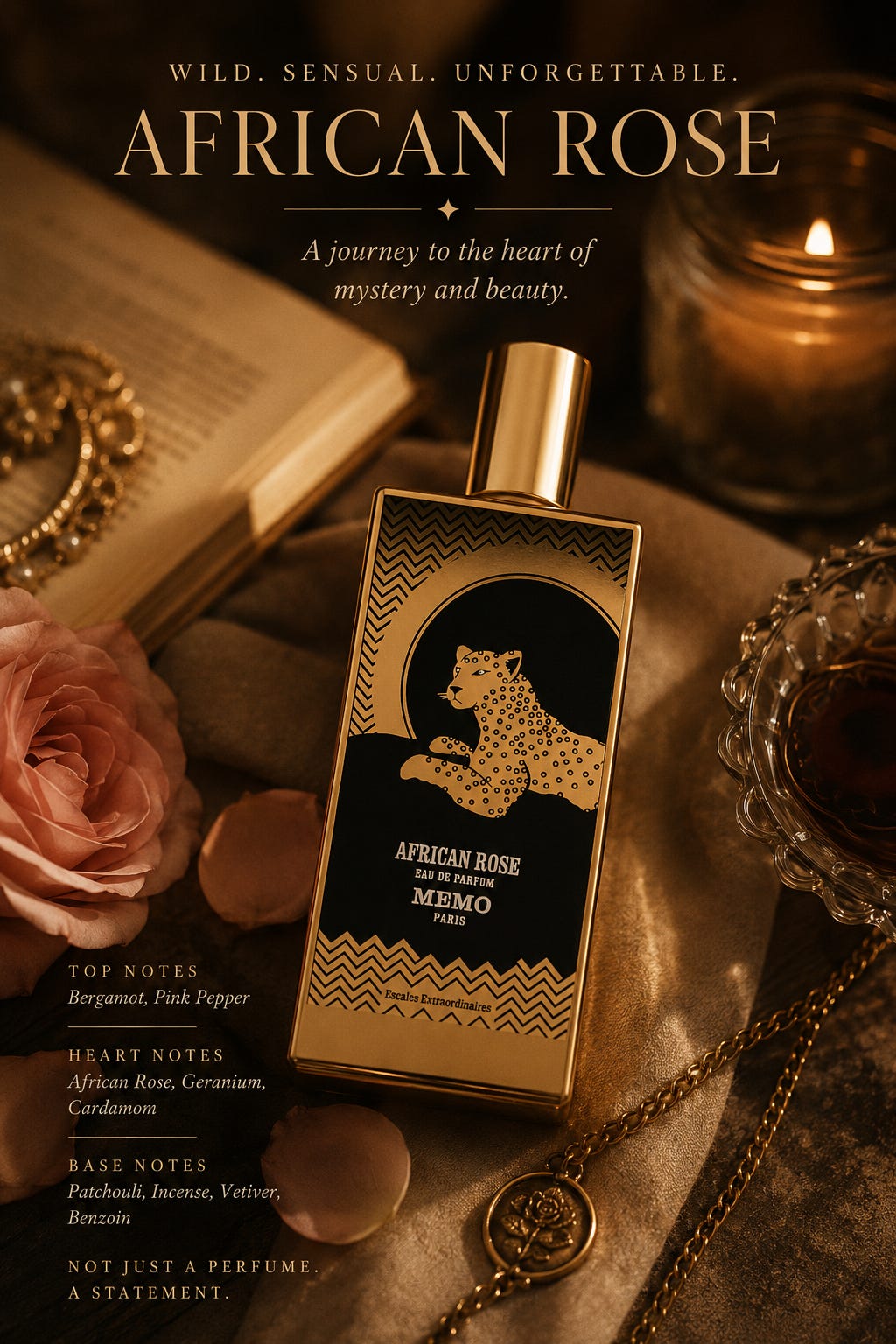
Wild. Sensual. Unforgettable. African Rose isn't asking you to smell like a flower — it's asking you to smell like you've just walked out of somewhere extraordinary.